11.12.2019

Here is a sobering report on the five college majors students most regret. Unfortunately, communication is one of them with 27% of students regretting their selecting communication as a major--with the most common complaint that it was too general.
https://www.cnbc.com/2019/11/12/the-5-college-majors-american-students-most-regret-picking.html

10.18.2019

Here's an interesting article on an important but rarely discussed (at least in our interpersonal texts) issue/problem:
https://thriveglobal.com/stories/how-to-say-no-white-lie-honesty-rejection/

WELL-BEING//

How to Decline an Invitation Without Hurting Your Relationship

Expert-backed strategies to RSVP “no” to anything and protect your well-being.

10.03.2019

How to Deal With People Who Interrupt You at Work

Your voice deserves to be heard, even if it’s not the loudest in the room.

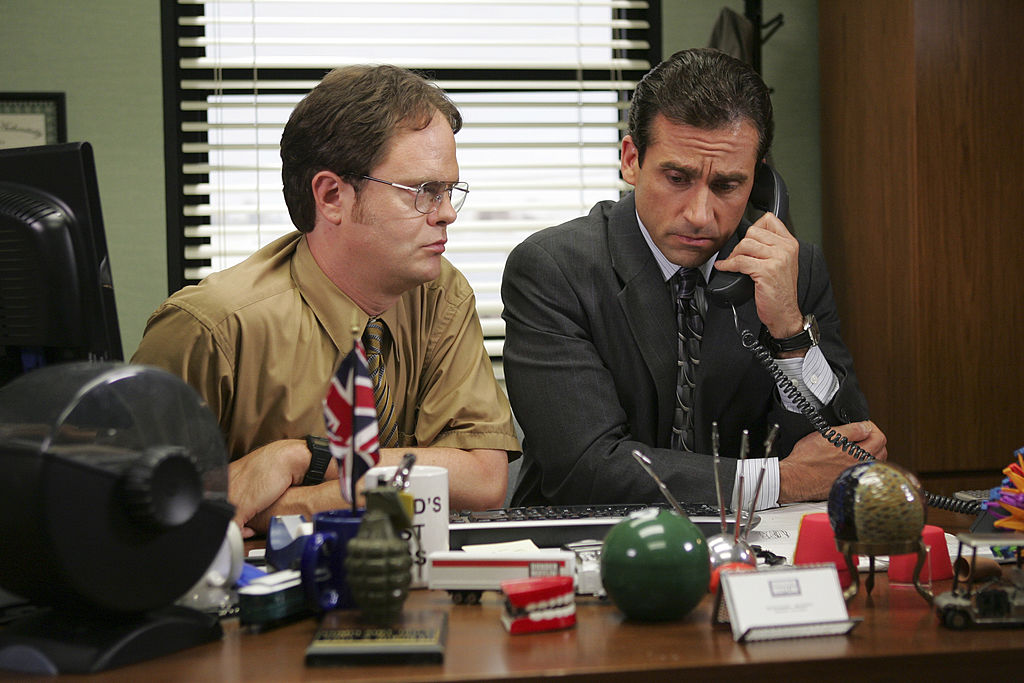
NBC / Contributor/ Getty Images
Whether you’re presenting in a team meeting, or pitching an idea to a group of executives, having a colleague interrupt you at work can be a stressful experience. Aside from the fact that it’s rude, the interruption itself can hold you back from getting your point across — and when it happens often, it can make you less passionate about the work you’re doing, and less happy at your job.
Research shows that employees who deal with continual interruptions experience more stress and increased feelings of frustration at work — and there’s good reason for that. “Getting interrupted can be stressful because it’s a challenge to your position,” Joseph DeVito, Ph.D., author of The Interpersonal Communication Book, tells Thrive. “Interruptions tell you — and others at the meeting — that you are not as important as the person doing the interrupting.” 
Rebecca Greenbaum, Ph.D., a professor at the Rutgers School of Management and Labor Relations, tells Thrive that handling interruptions starts with dealing with chronic interruptors: the colleagues at work who are at the source of your stress. And whether you’re naturally introverted or extroverted, confronting these individuals appropriately (with compassionate directness) can seem difficult.
If you consistently struggle with being heard because of others’ interruptions, the experience can ruin the way you feel about coming to work — and that needs to change. Here are a few tips to help you get started.
Confront compassionately
It can be daunting to speak up about feeling interrupted at work, but it’s important not to avoid confrontation altogether. After all, we know from research that sidestepping important issues only ends up backfiring, and that when it comes to having your voice heard, using it is step one. Greenbaum says avoiding the matter can actually worsen the situation “for the transgressor, for the workplace overall, and perhaps for you.” Instead, she suggests striving for “constructive confrontation.”  (At Thrive, we call this value “compassionate directness,” and it’s all about providing honest feedback in a way that improves company culture, by facilitating ongoing two-way conversation.) “Talk things out sooner than later,” Greenbaum adds. 
Differentiate between types
While interruptions can be incredibly impolite, remember that communication is often subjective, so what feels like an abrupt interruption to you could feel like a typical back-and-forth for someone else. “Realize that some interruptions at work meetings are normal, so don’t take those personally,” DeVito says. And if the interruption is subtle, he suggests telling your colleague, “Would you mind holding that thought,” or “Let me finish my thought.” Greenbaum adds that there’s a performance model called “trait activation theory,” where parts of our personalities get triggered depending on the circumstances — and being mindful of when you get offended can help you cope accordingly. “Knowing that we’re not limited to one type can allow us to grow,” she says.
Shift your POV
When one colleague in particular is a constant interruptor, it’s easy to start to see them in a negative light — and holding onto that negativity can prevent you from being happy at work. If you’ve already been honest and compassionately direct, Greenbaum says it may be time to be the bigger person, and give them the benefit of the doubt. “Try to see things from your coworker’s point-of-view,” she urges, “And if needed, forgive your coworker.” It’s tempting to feel stuck in your view of someone if they’ve continually interrupted you, but it’s important to remind yourself that we’re only human. “We’re all fallible,” Greenbaum adds. “You’ll feel much happier by moving past your differences.”
Follow us here and subscribe here for all the latest news on how you can keep Thriving. 
Stay up to date or catch-up on all our podcasts with Arianna Huffington here.

    7.27.2019

    Decorators: Please Don’t Touch the Dust Jackets


    This brief essay—which really should go in Architectural Digest, Dwell, Interior Design, Elle Décor, or House Beautiful—is about designing with books but also says something about communication and how our decorating says something about who we are.

    Recently, we had our loft decorated by a professional decorator who was excellent, except for one thing: He wanted to remove the dust jackets (book jackets, dust covers) from my rather extensive library. I resisted. But I figured that this may be a standard decorating principle and so I journeyed to the large department stores and where books were displayed, there were no dust jackets in sight. Apparently, it is a decorating principle, but one that needs to be revisited and removed from the decorator’s handbook.
    Dust jackets are integral to the book; they are a part of the book, not like a candy wrapper that is removed and thrown away. Dust jackets are a preview of the theme or the mood of the book and serve much the same purpose as the introduction or preface, but ideally in an extremely brief but visually arresting way. They tell the potential reader something important about the book, with their words obviously, but also with their fonts, colors, and visuals.
    Dust jackets serve an attention-gaining function, much like the introduction to a speech or article. They draw attention to the book; they invite you to look more extensively at the book, to spend some time with it. And, again, much like the introduction to a speech or article, they provide the potential reader with a preview, explaining or hinting at the content of the book, at what is to follow.
    Dust jackets individualize books. Whereas books without dust jackets look very much the same, dust jackets make each book visually distinct. And, of course, each book is distinct and different from every other book. Books without jackets lose a good part of this distinctiveness, a distinctiveness that adds variety--color and dimension—to a shelf that would otherwise be totally bland—especially when the books number in the hundreds.
    Dust jackets are given considerable attention by publishers and are often works of art. And although the dust jacket is nothing more than a type of poster, it still is a work of art that can be enjoyed in and of itself. Furthermore, if the book is a first edition or otherwise rare, it will be worth far less without its original dust jacket. So, by destroying the dust jacket, you destroy a good part of the value of the book, perhaps its total value. And you don’t want a client to discover that a once-valuable book is now worthless.
    Consider too the different messages that a bookcase of dust-jacketed books and jacket-less books communicate about your clients, who they are and what their priorities are. A good argument could be made that the impression the dust jackets create is of a lover of books, a reader, someone with a mind. The jacket-less books more likely communicate clients more concerned with appearance than substance.
    From a purely practical point of view, they help the user find the book, especially when the library is extensive. And once this now easy-to-find book is found, the jacket serves as a reminder of the mode or theme of the book.
    So, decorators, think about the important functions that dust jackets serve and consider the values of leaving them exactly where the publisher, designer, and author put them.